

How to give feedback people actually hear


In this article:
You say something to your team, and every time, you get a reaction. One person nods, another turns off their camera, a third just goes quiet. That's already feedback, even though you never announced a "feedback session." Ivan Rohovchenko suggests you look at it exactly that way: a system that runs all the time. And you charge it long before the hard conversation.
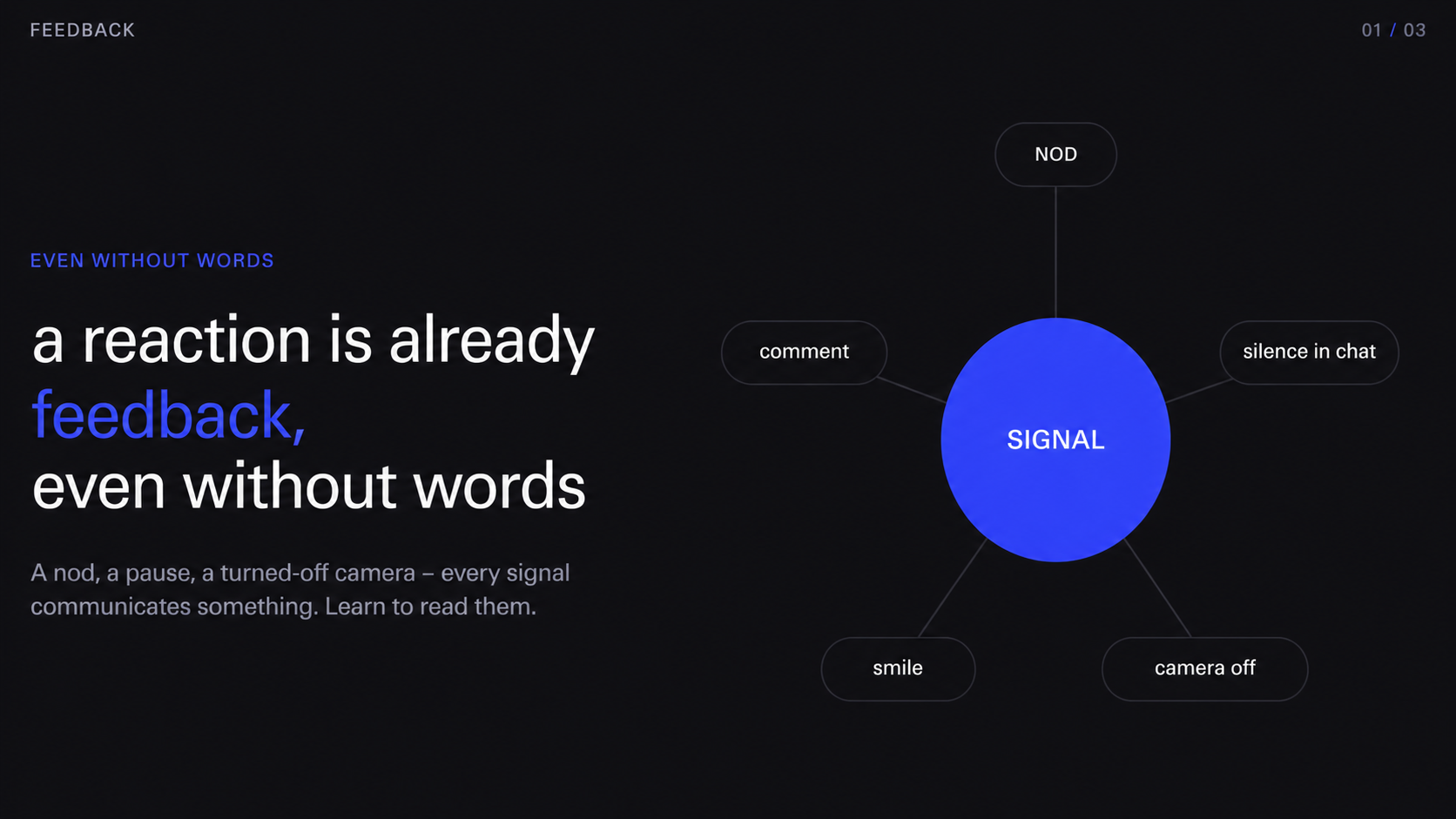
How feedback works as a system
Ivan borrowed the idea from control theory, which he studied back in his engineering days at Kyiv Polytechnic. There, feedback means a system's response to a signal: you send something to the input, and the system answers. Or stays silent. Silence is an answer too.
Designers know the feeling from interfaces. When you design an interaction, the user has to understand at every moment what state the system is in and where in the flow they're stuck. A team works the same way. A smile, a camera switched off, a nod, silence in the chat — a response to your every move.
Which leads to the point: feedback is a constant exchange of information, and a once-a-quarter meeting has nothing to do with it. The tighter the communication, the faster the team passes context around, and the more visibly the results grow.
How to charge the readiness battery
Readiness to hear criticism works like a battery. On a team where nobody talks about the work with anyone, the very first remark drops into a void. The person's defenses go up before you finish the sentence.
Defense takes two forms: fight or flight. Your colleague either jumps to argue or retreats into a shell and stops hearing you. The lower the battery, the thicker the walls of that shell.
Balance is what charges it. Ivan cites a rule from HBR: roughly five positive touches for every critical one. Praise only when it's earned, no handing it out like confetti. It's just that the small occasions to notice someone's work are far more plentiful than we usually make use of.
The better you've charged the readiness battery, the better the feedback lands.
When to give and when to ask for feedback
Most of these touches are quick notes on the fly: you show that you noticed the work. There are far more occasions for them than it seems, and almost none needs a separate meeting.
When to give
There's reason to give feedback at every stage:
- An interim result. Even when everything's fine, say that you're moving in the right direction.
- The end of a stage. Talk through what worked and what's worth tightening up next time.
- A first attempt. A colleague did motion design for the first time or picked up a new skill — mark it. Keep the same moment in mind when you hire and onboard a new designer: the first feedback after a hire sets the tone for everything that follows.
- Ingenuity. Someone introduced something of their own and others can see it. Praise it publicly.
- Built-up negativity. Don't let it pile up until it comes out as firings and fights.
- Constructive conflict. Two specialists genuinely fighting for the result without making it personal.
A special case is when a person starts asking for feedback on their own. That's a red flag: they're short on your attention and on input.
When to ask
A manager carries two jobs at once: doing the craft and leading the team. So you end up needing to ask for feedback even more often than you give it to others. Do it when you launch a new process, give a presentation, or have just started working with a new stakeholder — the same way it's worth building in regular feedback points during your first 30 days in a new management role.
Communicating up and sideways is its own thing. Managing up is the people above you in the structure; managing across is peers at your level. Asking for feedback upward, from other heads or the C-level, matters even more: that's often exactly where you don't fully understand your own task, the same way stakeholders on a design team often frame a request vaguely, and it's feedback that turns it into a resource you can manage.
How to give corrective feedback
Corrective feedback looks forward, to the next result. When something falls apart, the first impulse is to come in and dissect the whole failure. The managerial shift is exactly this: let go of the result that triggered the conversation and think about the next iteration.
Now the main thing. You take apart the work and leave the person out of it. Most likely your colleague already knows they messed up, so piling extra criticism on top will only shut them back into that same shell.
The structure of the conversation
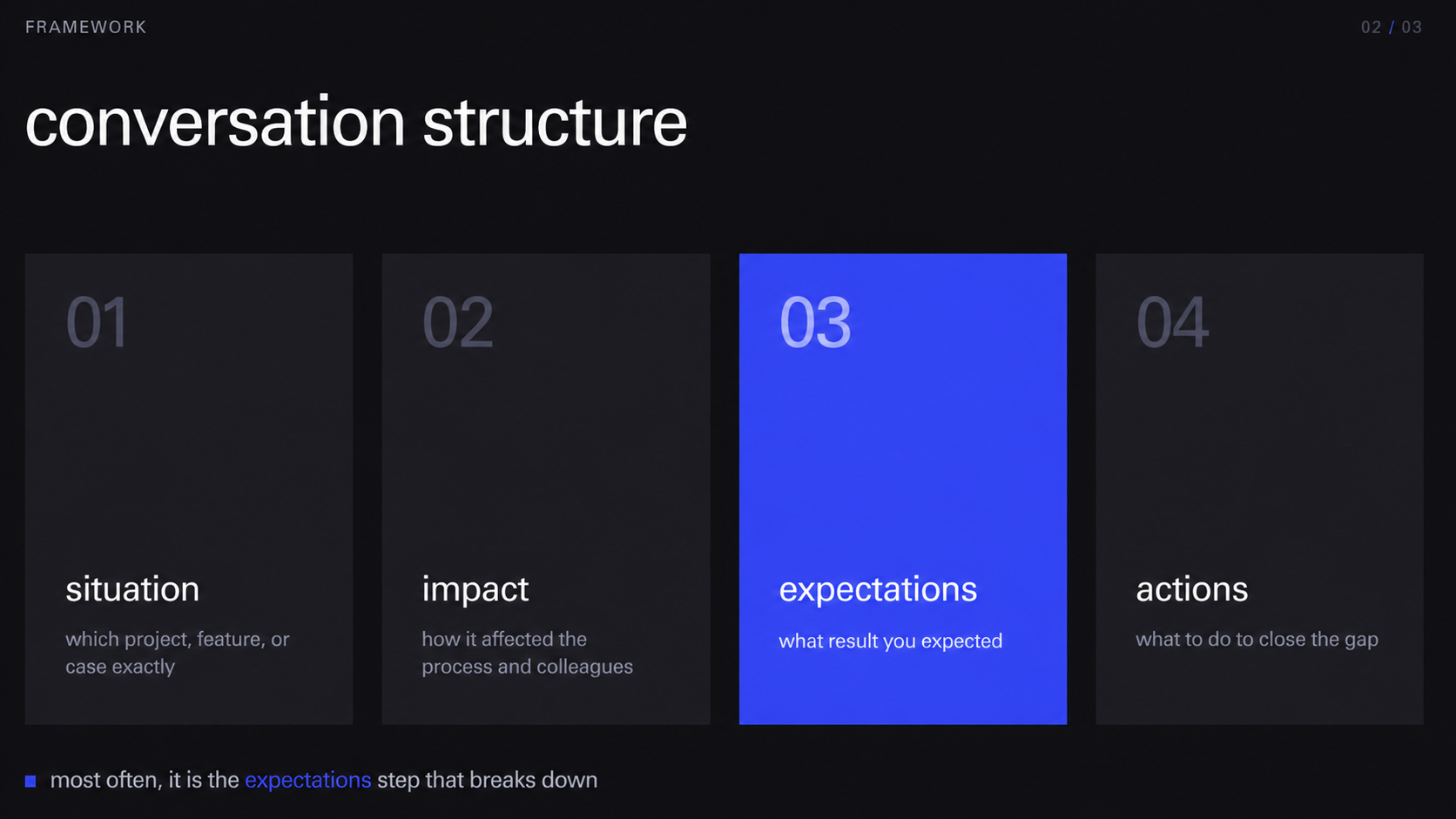
To get a plan out of the conversation, break it into four steps:
- Situation. Which project, feature, or case you're reviewing.
- Impact. How the result affected the process, the business, colleagues.
- Expectations. What result you were actually expecting.
- Actions. What to do to close the gap between what you have and what you need.
The step that fails most often is expectations. We only start spelling them out once it's already time to give feedback. But most tasks fall apart right at the start: nobody pinned down the expectations, context, and resources up front, the same gap that a clearly written split of roles and responsibilities in living risk management closes. Sometimes expectations are impossible to describe without a draft. On one team Ivan called a throwaway draft like that a "shit iteration": a quick, rough concept you show a client or founder so they'll finally say what they want.
Preparation, timing, and emotion
A serious conversation needs preparation. An agenda, specific cases, at least rough drafts of solutions — all of it should be in your head beforehand. Build in time buffers before and after, so you're not jumping into feedback straight out of a product meeting or rushing the last five minutes.
Better to let the emotion out earlier. Ivan admits it takes him a full day to cool down after a truly emotional episode. Your nervousness multiplied by your colleague's produces nothing but extra stress.
At the top-management level, emotion sometimes works as a tool: everyone reads it as a signal. Lower down, in middle management, it becomes a risk. And the main thing for a head is consistency. If you're calm today and blow up tomorrow, the team simply doesn't know what to expect from you, the same consistency worth cultivating if you plan to build a career in operations management.
How to phrase it without triggering defensiveness
Phrasing decides almost everything: whether the person hears you or shuts down. The technique is simple: show how the situation hurts the work. About the person's character, not a word.
Compare two sentences. "You're always late and you don't value my time" is a direct attack, and plenty of people dig in after it. "It's hard for me to rearrange my schedule when the start of a meeting keeps shifting" is the same situation, now without the accusation.
Same trick with design. Turn "the mistakes in your design make it harder to sell" into a proposal: "let's collect feedback from the client, it'll help us approve the concept faster." You're discussing the same thing, but you skip the emotional blowup.
A deeper level still is to drop the word "you." "I can see the atmosphere on the team is tense" leaves the door open. "You're the one causing conflict" sounds like a verdict. And remember: calm, clear phrasing hits harder than emotional phrasing, because it adds weight and confidence.
There's no universal tone. A senior will take it straight, no sugar-coating, because they know themselves when they've messed up. A junior is worth giving a bit more support. Which makes a manager part psychologist here: you have to sense how each person takes a hit.
How to handle difficult employees
You're not responsible for other people's mistakes. That's probably the hardest thing to accept. A manager's job is to create the conditions and hand over the tools. You're not obligated to do the work in someone's place.
If someone stalls for a long time with no objective reason, your room to act is narrow but specific. First, help them see where exactly the mismatch is: speed, quality, something technical. Then offer a tool: extra sessions, courses, coaching.
Whether they use it is their call. Working yourself up and dragging someone along by force isn't worth it. You gave the feedback, named the expectations, gave time and a chance. From there the responsibility passes to the employee, the same principle that handing over ownership in delegation rests on: without room for their own decisions, a person will never start owning the result.
With aggressive or toxic people the logic is the same. You're not their parent, and you didn't sign up to reform them. Your job is to deliver the feedback calmly, sometimes in writing, keeping in mind that an aggressive person will answer with aggression. That's normal.
How to build a feedback culture
This whole structure rests on one thing: the team has to get used to talking about results out loud. Where people run retros, comment on each other's files and Figma, and calmly hear opinions about their work, sharp feedback doesn't hit them out of nowhere.
Your consistency is part of that culture too. To your team, you're a product, the same as an app is to its user: the interaction has to be predictable. A manager who's one person today and another tomorrow keeps the team permanently guessing.
So be available for feedback about yourself. Give people a channel to criticize the leadership: 1:1s, the shared meetings actually worth gathering for, a form, a Slack bot. And grow a culture where finding a mistake is normal, even good.
There's no such thing as people who don't make mistakes. There are people who hide them — and that's the real problem.
How to practice
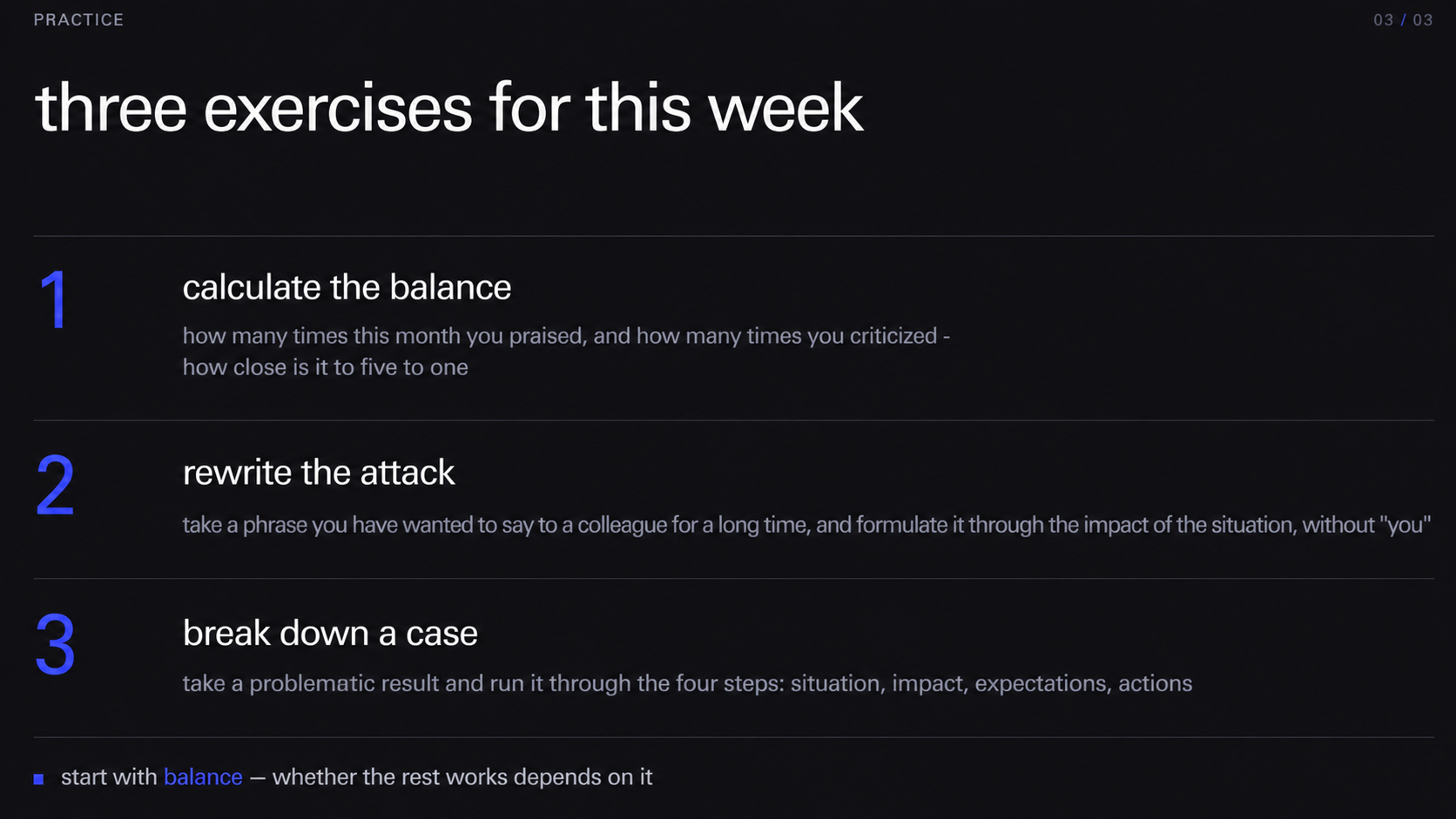
Three exercises to get all this into your work this week.
- Count the balance. Think back over the last month: how many times did you praise, how many times did you criticize? Estimate how close that is to five to one.
- Rewrite an attack. Take a sentence you've been meaning to say to a colleague and reframe it through the impact of the situation, without a single "you."
- Work through a case. Take a problem result and run it through the four steps: situation, impact, expectations, actions.
Start with the balance, since everything else depends on it. After a few months of practice like this, hard conversations will come noticeably easier.
grow your careerwith real-world knowledge
feedback as a systemfrequently asked questions
- What makes feedback constructive instead of just criticism?
- How do you give feedback to an employee without making them defensive?
- How much praise should you give for every piece of criticism?
- How often should managers give feedback to their team?
more interesting articlesfor you


