

The one-word test that separates a real insight from a fake


In this article:
- [01]How strategy changes consumer behavior
- [02]How five questions lead to the insight
- [03]How to recognize a real insight
- [04]How to formulate an insight in three steps
- [05]How to move from insight to value proposition
- [06]How to check that an insight isn't fake
- [07]How to choose a communication angle: the four forces
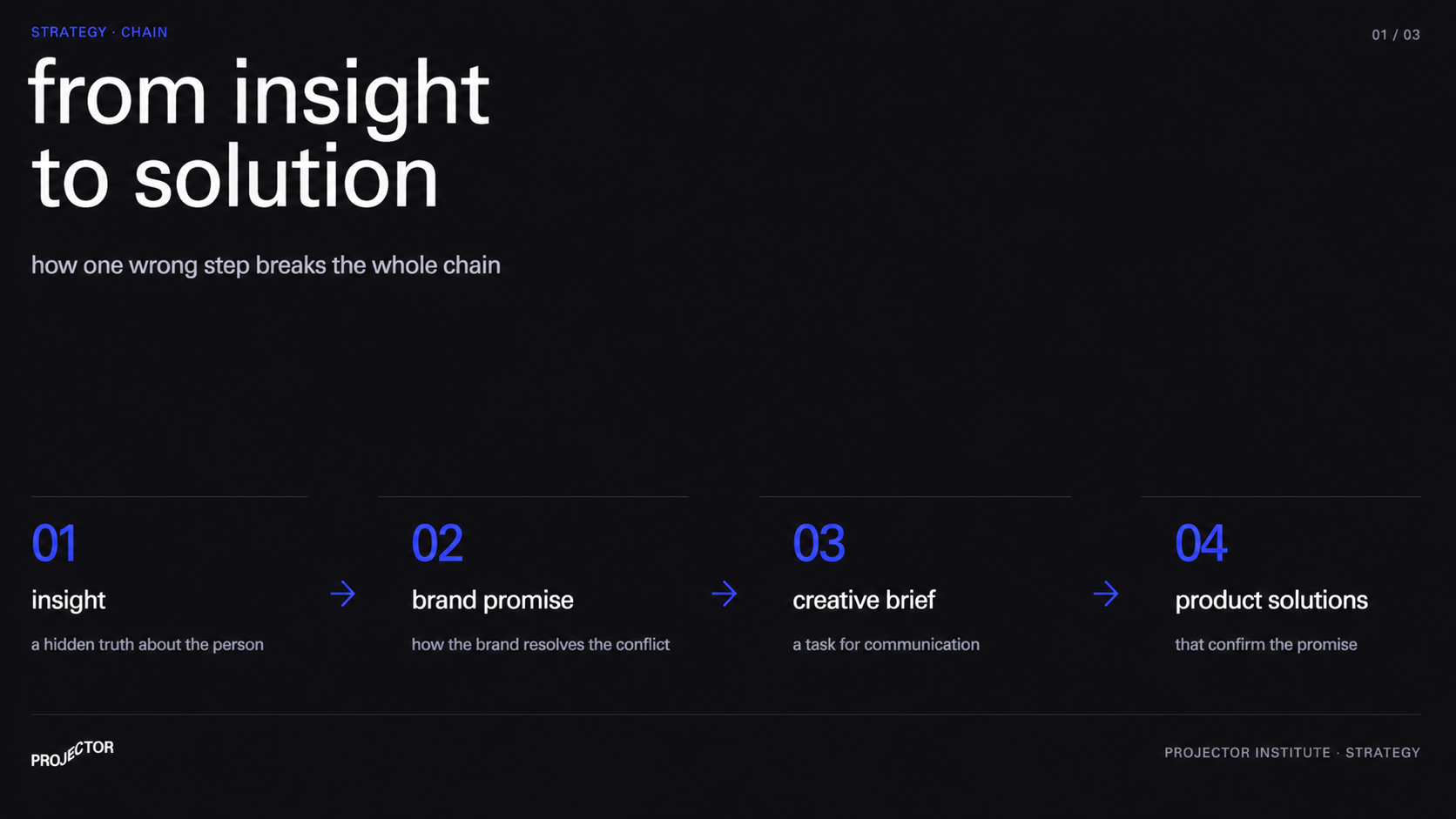
On the market, people spell "insight" like "inside" and slap it onto any observation at all. But in brand strategy it's two or three lines that hold up the brand promise, and behind that the creative brief and even product decisions. Get the wording wrong and the chain breaks at the very first link. So you have to learn to find an insight and check it for fakeness at the same time.
How strategy changes consumer behavior
The job of strategy isn't to produce slick creative — it's to change how people behave. Andriy Fedoriv puts it this way: marketing is the science of how to influence a consumer's choice. Behavior comes down to four things: what a person buys, when, why, and how often.
There are three ways to change that behavior. The first is to switch people into a category. People lend money to friends on trust, and friendships regularly break over it, so a service that sorts out the debts between people close to you creates a whole new category of solution. The second way is to become part of the repertoire, the way BODO did in the gifts market: money and perfume already lived there, experiences didn't yet. Kombucha Spraga is the same idea: showing up in the fridge instead of cola. And the third is to crank up the frequency. At Agromat, people buy building materials once every few years for a big renovation, and the whole task revolves around the purchases in between those renovations.
Which way fits a given brand is something five questions will tell you.
How five questions lead to the insight
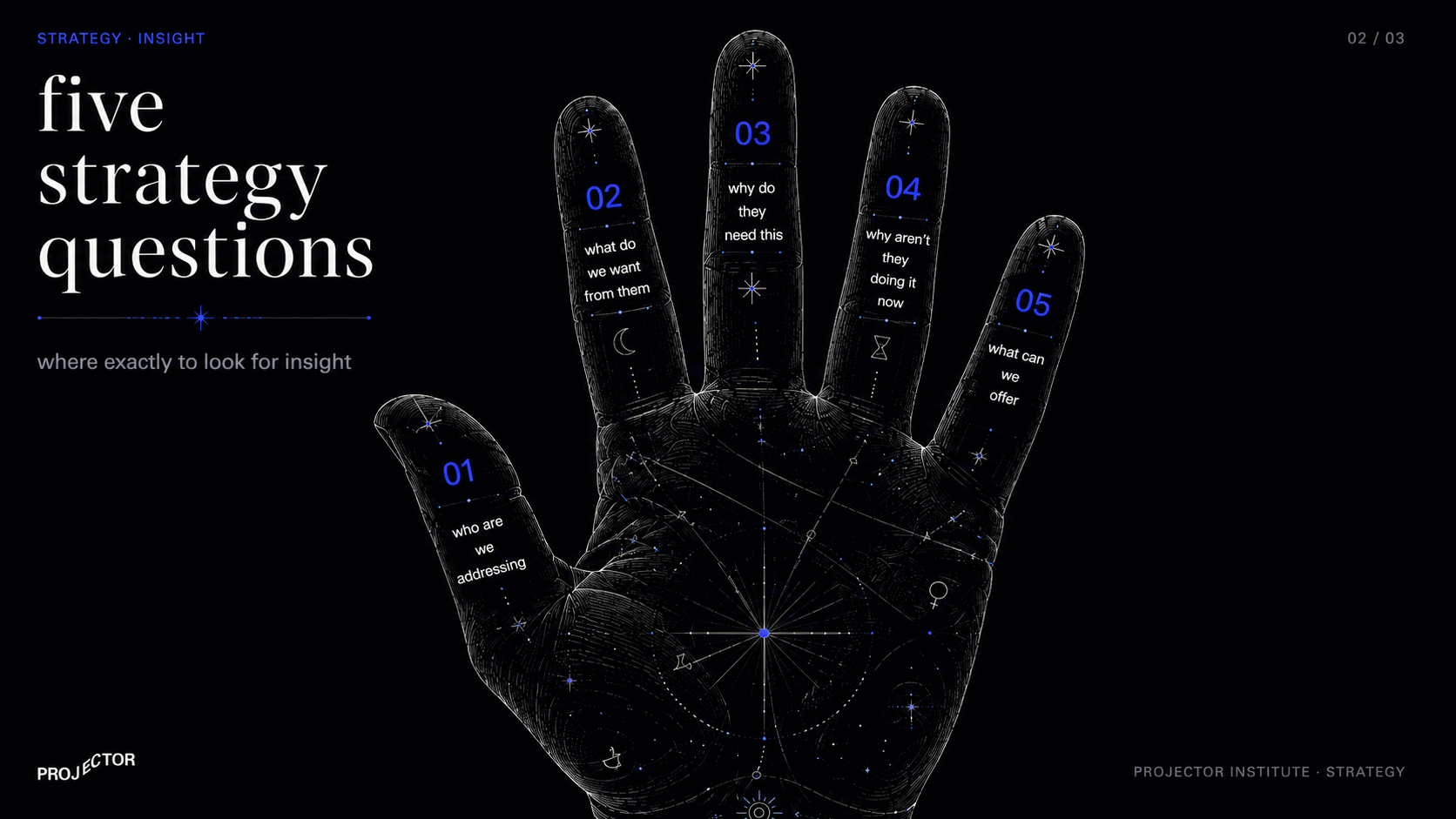
Five questions structure all the information a strategy needs, and they show exactly where to look for the insight.
- Who are we talking to? At the start of a project this is the client's description of the target audience. After the interviews, it's the motivational segment you've decided to work with.
- What do we want from them? A behavioral change: drive the category, become the repertoire, or grow the frequency. The answer decides who you'll talk to next. Want to switch electronics shoppers from offline to online? You go interview the people who shop in physical stores.
- Why do they need it? The motivation you dig up in the interviews.
- Why aren't they doing it already? The barriers.
- What can we offer so they'll change their behavior? The brand's value proposition.
You look for it at the intersection of the third and fourth questions: "why they need it" plus "why they aren't doing it already."
To keep the answers from going vague, take a headliner (your single best interview) and frame the marketing task through one specific person. The same principle works when you compress an interview into the "when I want to — I want" formula: the specifics of one person beat an averaged-out portrait. Say: "How do we get tired Oksana, who's afraid to quit because she doesn't believe she'll find a new job, to look for openings on Work.ua?" Most people skip a task slide like this at the start of the strategy block. They shouldn't.
How to recognize a real insight
An insight is a hidden truth about a person that sheds new light on their problem. Not a statement of fact, but an exposé: why the consumer thinks the way they think and says what they say. The strategist works as a detective here, because in interviews people dress up reality.
"An insight is a motivational conflict your brand can resolve."
The conflict itself looks like this: "I want a double Big Mac — but then why do I even go to the gym?" That's not an insight yet, it's a drama: a person wants something and for some reason isn't doing it. This is exactly the kind of drama worth fishing out of every interview, especially on your first projects.
Here's how a drama becomes an insight. On a project for an electronics store, the problem sounded like "people don't buy new appliances because they think it's wasteful." Sounds logical, seemingly nowhere left to dig. But in an interview one respondent told us she didn't replace her washing machine until it started jumping into the middle of the bathroom, and another went to an important meeting half-shaven because his old razor "still works." The insight: "Actually, I buy new appliances when I convince myself I deserve them."
How to formulate an insight in three steps
The working formula for an insight has two parts: the real motivation plus what's getting in the person's way.
- Step 1. Formulate the real motivation. A mother in an interview about a kids' studio talks first about "cool teachers" or a location nearby. Dig deeper and it turns out: she wants her child to have choices in life and something they genuinely love doing.
- Step 2. Describe what's stopping her from getting it. School doesn't provide it: it teaches algebra out of Soviet-era textbooks and kills any desire to grow.
- Step 3. Make sure the product resolves this conflict. The studio needs the methodology and hands-on practice that back the promise up. If the strategy forces you to change the product, the task isn't done.
The motivation in step one comes only from the interviews, from the block about motivation. Made up at your desk, it won't survive the test, not by the product and not by the client. The shortest path to it runs through the context of a person's life: the question "why do you order delivery" gives you rational packaging, while "what was going on in your day and week when that delivery habit appeared" gives you solid ground. One respondent couldn't explain why he kept a stash of dumplings at home, until a conversation about his life pulled the answer out: a pile of projects, no time to cook, and a strategic reserve of dumplings in the freezer as insurance for the evening when he's got zero energy left. The techniques for that kind of conversation, from the purchase timeline to working with abstractions, we broke down in a separate piece on the JTBD interview.
Sometimes you turn one insight over for a few days. That's normal: you're looking for a person's drama and, at the same time, the way a brand can resolve it.
How to move from insight to value proposition
A value proposition is how a brand resolves the conflict you found, or answers the motivation. Insight and proposition flow into each other. "I want my child to have choices, but school doesn't provide that," and out comes a studio that unlocks a child's potential. "I start investing for passive income and instead I get a second job," and from there an app that makes investing simple. And from "actually, I eat sweets in joy and in sorrow, but every time I look for an excuse" a patisserie is born, the one that's a celebration whenever you want it.
Does the wording feel too simple? Good. Fancy words break the creative brief and product development. The more primitive it comes out at the start, the faster you'll get the hang of it, and the brilliant phrasing comes on its own later.
The product has to back the promise up, though. You can only say "investing is simple" if the app really does have personal guidance or a clear beginner's guide.
How to check that an insight isn't fake
Before you carry an insight into the strategy, run it through four checks. They sift out the fluff faster than any discussion can.
The "actually" test. Put the word in front of your wording and read it aloud. "Actually, I enjoy my job" rings false; that's not how people talk. "Actually, I didn't win the genetic lottery and I don't look like the beauties on Instagram" is the raw truth of a specific person, something you can work with.
The person-at-the-center check. "I drink this lemonade because it has less sugar": there's a product here and no person with their drama. So it's not an insight.
The rational-cover check. Answers like "I buy it because it's on sale" are mostly packaging. Real discount-hunters do exist, but they're a rare few; for most people a deeper motivation hides behind the rational reason.
The value-proposition check. Does the proposition come out crooked, or refuse to come at all? Step back one step. The problem is almost always in the insight.
"A badly worded insight breaks the brand promise, and behind it the creative brief and the product decisions."
Passed all four? Then the insight is ready to move on, into communication.
How to choose a communication angle: the four forces
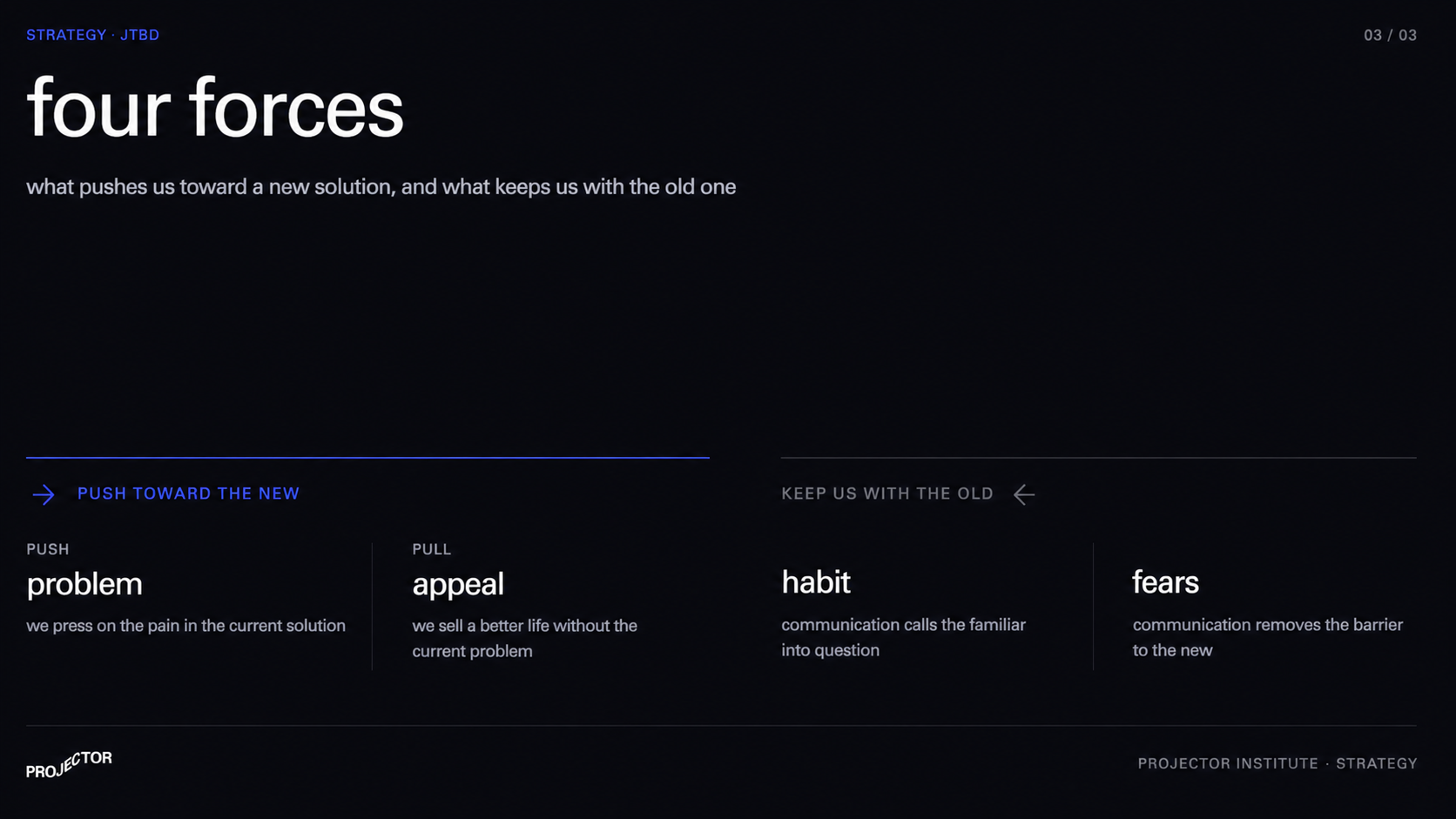
The "four forces" framework from Intercom's book on Jobs to Be Done explains the mechanics of choice. Two things push a person toward a new solution, two keep them next to the old one.
- The problem with the current solution (push). The washing machine leaps into the middle of the bathroom — time to replace it. In communication we press on what hurts: like the spot for a medical brand where a patient finally hears her doctor explain things in plain human language.
- The appeal of the new solution (pull). There might be no problem at all, and then we sell a better life. The Google Assistant ad shows no suffering: just how convenient it is to say "Hey Google" straight from the shower.
- Habit. "I go to the supermarket because Mom went and Dad went." Communication calls the habit into question. That's how eToro pokes fun, with humor, at the usual ideas about investing.
- Fears. "Everyone at the gym is beautiful, I'm not going there." In Find Your Greatness, Nike removes that fear: greatness belongs to everyone who goes looking for it.
Which one to work with is decided by the size of the segment: when most respondents have no pronounced problem but want a better life, strengthen the magnetism of the new solution. Exactly how to segment by motivation and pick a segment is a separate topic. The forces can be combined in sequence. For Spraga we brought two brand models: first the communication on habit ("I want to look 30 at 30, but I drink cola every day"), and only then on the pull toward sweetness, where the kombucha becomes a new dessert.
This is a tool for internal work and briefing the creative team. Showing the diagram to the client usually makes no sense: on the Ministry of Education project only the researcher on the client's side grasped it.
When there's no research: the communication insight
A communication insight is a truth about a person that makes them recognize themselves in an ad. The reaction, in Andriy Fedoriv's words: "How do they know this?" It saves you when there's no money or time for research and the strategy was needed yesterday.
A textbook example: the 18+ scene in a movie right as your parents sit down next to you. That awkwardness was the foundation for a TV provider's ad about channel blocking. Research had nothing to do with it. Just a situation everyone recognizes themselves in.
You can validate hypotheses like these without interviews. The most reliable route is memes and TikTok: if a topic lives in memes, the communication will most likely land. Quantitative research or ordinary conversations with friends work too. Be careful with self-analysis, though: your own lens distorts the picture.
An insight looks like two lines on a slide, but it's what decides whether the project flows onward. Try it today: take three answers from your last interview, put the word "actually" in front of each one, and see which ones survive. Back the survivors up with the product, and the creative team will know what to do — without a single fancy word.
grow your careerwith real-world knowledge
JTBDfrequently asked questions
- What is a consumer insight in marketing?
- How do you find a consumer insight?
- What's an example of a consumer insight?
- How can you tell a real consumer insight from a fake one?